In order to calculate the insured earnings, the fields “Demage Detail” and “Claim: Insured Earnings” in the Absences section must be filled out for the salary types subject to UVG/KTG that are to be transmitted. Please note: Not every salary type subject to UVG or KTG needs to be set up for KLE.
Insured earnings are determined in accordance with statutory provisions and contractual terms. If there is any uncertainty when setting up the salary types, this should be clarified with the insurer. In order for SwissSalary to calculate the values for the “Annual Wage” story and thereby provide the insurer with the basis for calculating insured earnings, the salary types must be set up as described above. The data provided by the policyholder is used by the insurer to calculate the daily benefit rate.
By applying a filter to the salary types subject to UVG/KTG, you can quickly display all salary types that need to be set up accordingly. Do not set up wage types with a negative calculation type, such as “Daily Benefit Correction,” for KLE. They cause errors when the insurer imports the XML file.
Note: According to Art. 22 UVV I, family allowances are also part of the insured earnings.
The sums of wage types are combined in different wage bases due to their character.
=> open salary types, use Personalize to insert fields Accident details, Accident insured earnings and KLE salary type of working hours lost due to accident.
The salary types can be quickly filled in via Manage - Edit list.
Examples of some wage types; this list is not exhaustive.
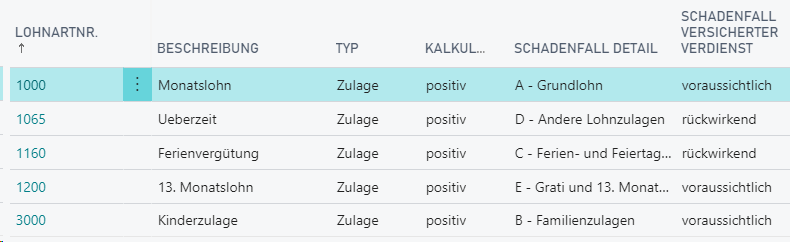
Demage Detail
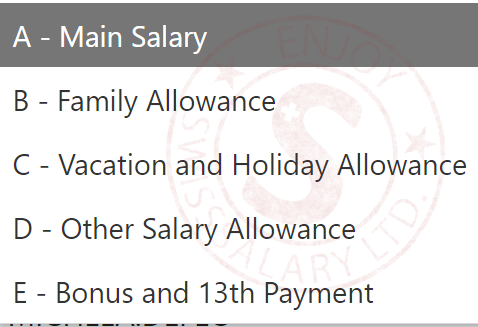
Possible selection fields in the Accident details field:
Damage insured salary
There are two different ways of considering wage types: expected (also called current) and retrospective.
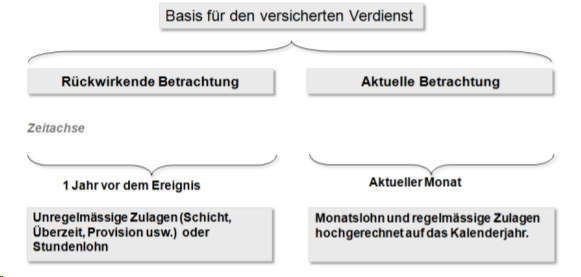
An example with current consideration of salary types (expected, regularly recurring wage components)
The current assessment is based on the portion of income that a person earns immediately prior to the event. It applies to all individuals who receive a monthly salary. This means SwissSalary takes into account the salary data (pay types with current assessment) for the month of the event. Depending on the information stored in the absence entitlement,
the applicable pay types are multiplied by 12 or 13 and totaled.
An example with retrospective consideration of wage types (irregular wage components)
SwissSalary calculates 12 months backward from the month prior to the date of the event. If the period is shorter (employment < 12 months), SwissSalary adjusts the calculation to 365 days.
KLE salarye type of working hours lost due to accident
Working hours lost are individual absences of a person at least partially able to work related to the insured event (e.g., doctor appointment, physiotherapy). Working hours lost can be reported in Hours with an additional wage type, e.g. Paid absence or Paid brief absence. The box below must be checked for this wage type:
Exact information about reporting working hours lost => Special cases - Working hours lost