SwissSalary REST API
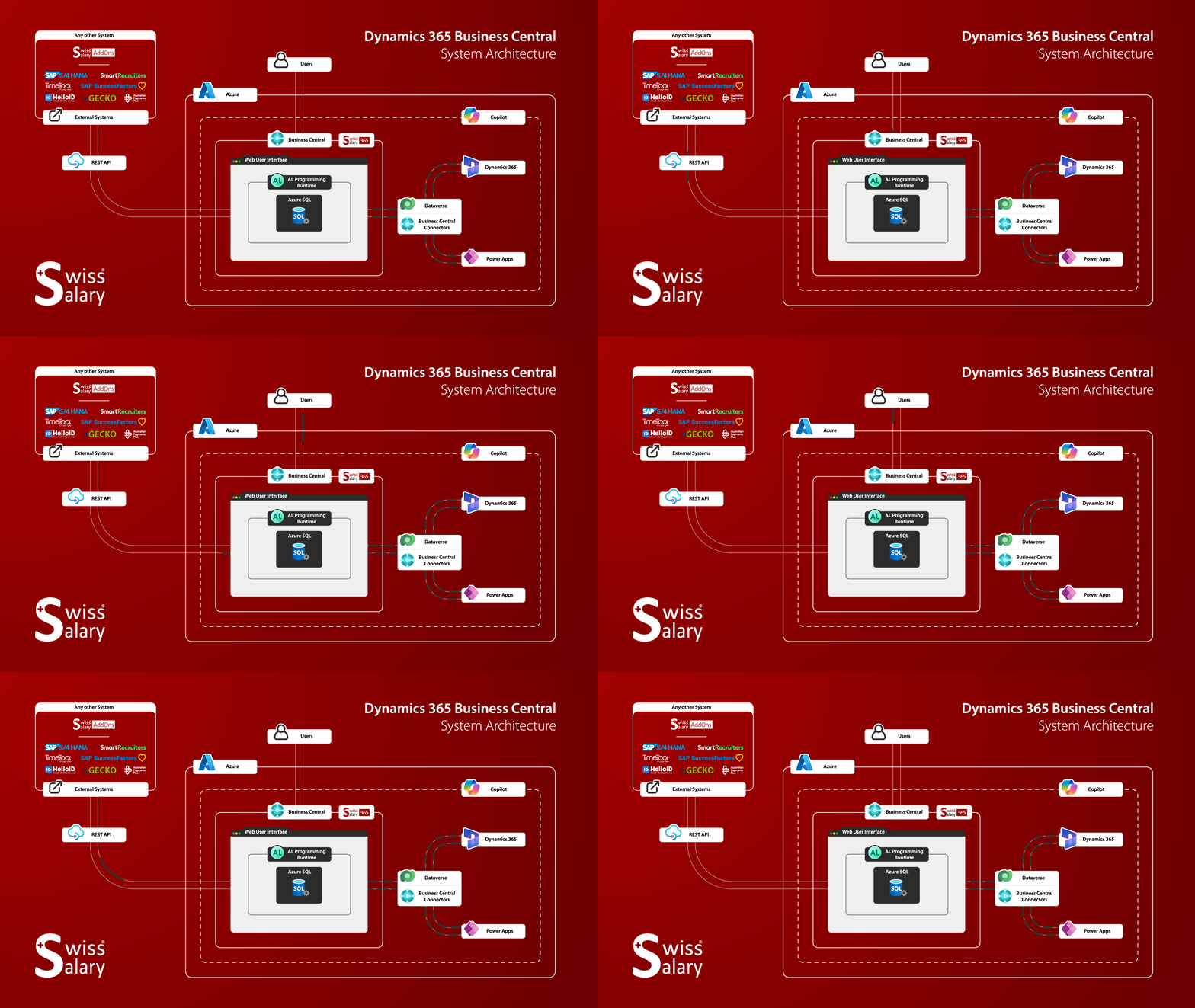
Introduction to the REST API and OAUTH for SwissSalary 365
SwissSalary 365 is a well-established payroll software for Switzerland and Liechtenstein based on the modern ERP solution Microsoft Dynamics 365 Business Central. The SwissSalary 365 app can be downloaded from the Microsoft AppSource Store. The free SwissSalary Cloud Essentials app is also available on the AppSource for advanced features like external system integration via REST API endpoints. This app, presented on the following pages, complements SwissSalary 365 with various features that enable seamless integration and communication with other applications.
What is a REST API?
A REST API (Representational State Transfer) enables secure and standardized data exchange between
different systems over the Internet.
It is based on the HTTP protocol and uses established methods like GET, POST, PUT, and DELETE to read,
create, update, and delete data.
Owing to this technology, systems can communicate with each other in real time. All connected
applications remain synchronized at all times.
No manual file transfers, only direct, secure and compliant transfers from service to service.
The SwissSalary 365 REST API enables simple and efficient integration of the app’s functions and data
into other systems.
It supports both read and write access, therefore providing the foundation for modern, seamless system
infrastructures.
REST-based integrations are now considered state-of-the-art and are an established standard in
contemporary software solution development.
What is OAuth?
OAuth 2.0 (Open Authorization) is an open standard that enables secure and user-friendly authorization
requiring no password sharing from users.
Instead, applications are granted temporary access to certain resources after the user has explicitly
given consent.
With OAuth 2.0, users can securely and conveniently access the SwissSalary 365 REST integration and manage data without directly disclosing their credentials. This process meets the current security standard and is used by leading providers worldwide, including Microsoft.
Why are REST API and OAUTH important?
Both REST API and OAUTH are crucial for SwissSalary 365 integration and security.
The REST API allows partners and customers to integrate the app’s features into their own systems and
create automated processes.
OAUTH ensures that these integrations are secure along with user data protection.
Together, these technologies enable flexible and secure use of SwissSalary 365.
What is OData?
OData (Open Data Protocol) is an open standard developed by Microsoft that enables structured access to
data via HTTP.
Based on proven web technologies like HTTP, URI, AtomPub, and JSON, OData offers a uniform way to read,
filter, sort, and update data – without any complex programming.
In the world of Microsoft Dynamics 365 Business Central, OData allows access to virtually all data in
the system.
So-called Pages (Page Objects) are used as the source of data.
They provide information in a simplified form, allowing developers to work with it even without detailed
knowledge of internal table structures.
Using simple URLs like .../ODataV4/Customers,
customers, items, or journal entries can be specifically queried and edited.
What is the difference between OData and REST API?
REST APIs have established themselves as the leading standard for integrating modern web applications.
They are flexible, easy to understand, and, owing to their clear structure, particularly easy to
implement.
REST APIs use HTTP and typically work with JSON, a compact, widely used data format.
Compared to OData, which is based on a more formal model with a defined query vocabulary, REST APIs
offer significantly more freedom in design and use.
This flexibility enables customized integrations that are optimally tailored to individual requirements.
Furthermore, the REST technology is generally better documented and preferred by developers due to its
simplicity and scalability.
The REST API represents a particularly powerful solution for modern system infrastructures that focus on
speed, security and future viability.